Should I Sell My West Palm Beach Retail Property Off-Market or Through a Full Listing Campaign?
A Palm Beach County case study on preparation, strategy, and what 15% actually looks like.
That is the wrong first question.
The right first question is: what are you trying to accomplish? The strategy — off-market or full campaign — follows from the answer. My job is not to tell a seller which path is correct. My job is to understand their goal clearly enough to add value in executing it, whichever direction that leads.
What I can tell you is that execution quality matters more than strategy selection. A well-run full campaign outperforms a poorly run off-market process. A well-prepared off-market transaction outperforms a broad campaign that generates the wrong buyers. The difference in outcome is not the approach. It is the preparation behind it — and the relationships that make both possible.
What kills deals in both scenarios is the same thing: surprises after contract. Zoning questions that surface during due diligence. A buyer who ties up a retail property for 90 days only to renegotiate or walk. A financing contingency that extends the timeline while the seller waits. An inspection period that drags because the buyer was never properly educated before going to contract. These are not market problems. They are preparation problems — and preparation is entirely within the broker's control.
The Deal: Retail Property and Redevelopment Site on Palm Beach Lakes Boulevard, West Palm Beach
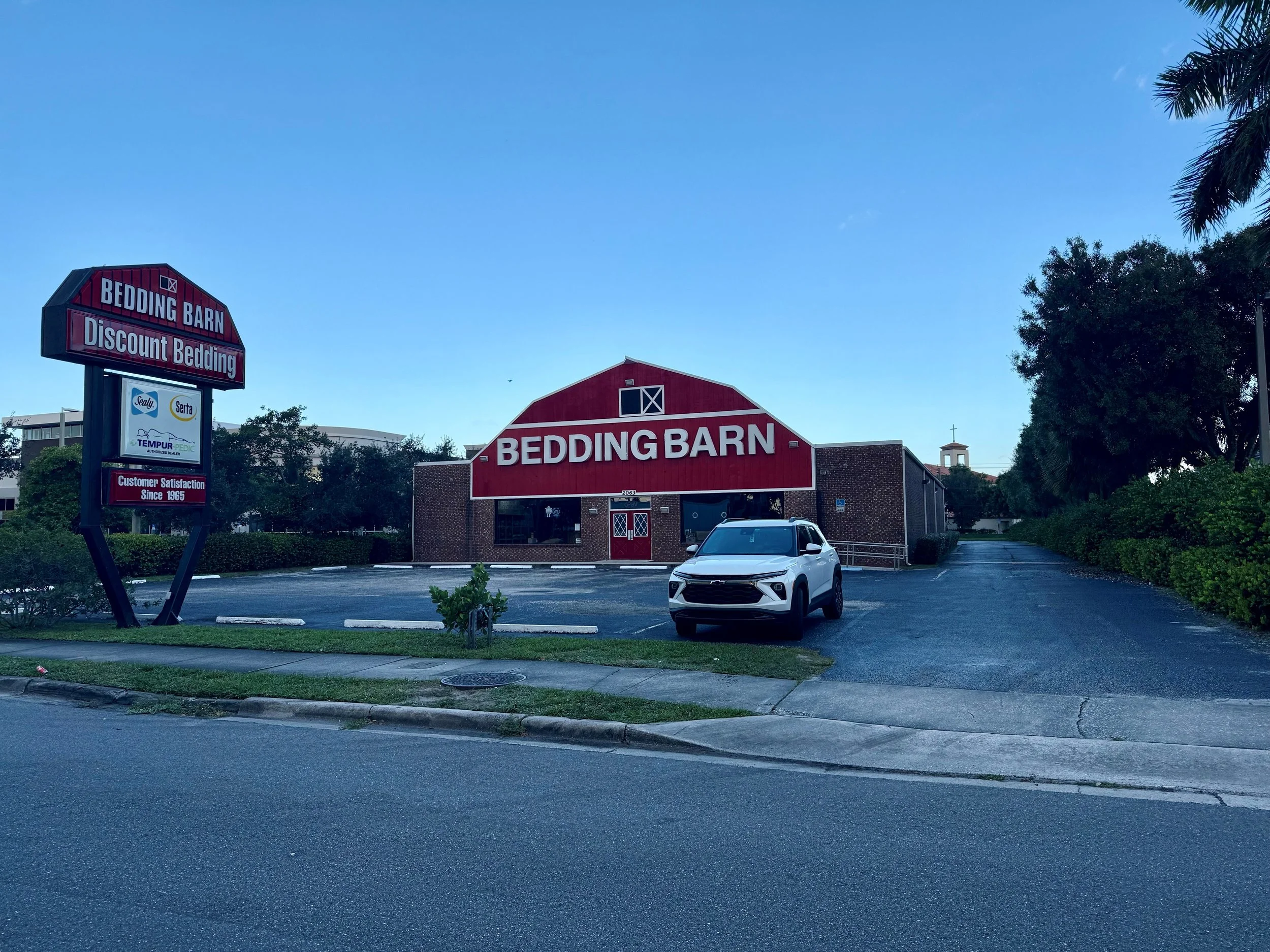
2063 Palm Beach Lakes Blvd, West Palm Beach — formerly Bedding Barn. Sold for $3.5 million, all-cash, to City Furniture for redevelopment. Represented by Nick McAndrew, Marcus & Millichap.
In March 2026, I represented a private trust in the sale of 2063 Palm Beach Lakes Blvd — an 8,450-square-foot freestanding retail property on one of West Palm Beach's most active commercial corridors. The building was vacant at the time of sale, previously occupied by Bedding Barn, and sat on just under an acre of commercial land in Palm Beach County.
The property sold for $3.5 million, all-cash, to City Furniture, which acquired the parcel adjacent to their existing West Palm Beach location as part of a plan to expand their footprint and redevelop the site. The transaction was covered by Shopping Center Business and the Marcus & Millichap press release.
Off-market. All-cash. 7-day inspection. 60-day close.
None of that was a coincidence.
What the Seller Was Already Being Offered
Before I brought City Furniture to the table, the seller had already received unsolicited offers on this West Palm Beach retail property — some directly, some through other brokers. Every one of those buyers required 120 days of due diligence and another 90 days to close. That is over seven months of the seller's property tied to a buyer with no certainty of outcome at the end of it.
The City Furniture transaction was all-cash, closed in 60 days with a 7-day inspection period, and netted the seller 15% more than his next highest offer. No financing contingency. No lender timeline. No renegotiation at the appraisal.
For a commercial property owner in Palm Beach County evaluating competing offers, those three variables — cash, timeline, and certainty — are often worth more than the headline number on a financed offer. A higher price with a 90-day financing contingency is not the same as a lower price that closes.
That 15% gap is not a market condition. It is what happens when the right buyer is identified, qualified, and prepared before a contract is ever signed.
What I Did Before Contract
The seller's goal was straightforward: a clean close, a strong price, and no surprises. My job was to add value in getting him there.
Before this seller was ever tied to a buyer, I engaged directly with the City of West Palm Beach to confirm zoning for City Furniture's intended redevelopment use. I then relayed that information to the buyer before we went to contract.
I do this because a buyer who understands exactly what they are acquiring before the inspection period begins does not need 120 days to figure it out during it. The due diligence period exists to confirm what is already known — not to discover what should have been answered earlier.
By the time both parties signed, City Furniture had already worked through the questions that derail most commercial transactions. Combined with an all-cash buyer, the absence of a financing contingency meant the seller's exposure window was defined and short. The inspection period was seven days because there was nothing left to discover.
That is not a special service reserved for large transactions. It is how I approach every deal regardless of size — because the seller's goal deserves that standard every time.
When Your Property Is Worth More as a Redevelopment Site Than as a Building
The 2063 Palm Beach Lakes Blvd transaction was not a retail sale in the traditional sense. It was a land sale.
The building — a vacant 1979 retail structure — was not the asset that drove the price. The 0.87 acres along a major West Palm Beach commercial corridor, sitting directly adjacent to an expanding retailer's existing footprint, was the asset. City Furniture was not buying a building. They were buying commercial land with confirmed zoning and a location that solved a specific operational problem.
This distinction — between what a property is and what it is worth to the right buyer — is what highest-and-best-use analysis is designed to answer. It is also one of the most consistently overlooked questions in commercial real estate, because most brokers price the building instead of the land beneath it.
For Palm Beach County property owners, the question of whether your asset is better positioned as a retail investment or a commercial redevelopment site depends on several factors:
Location along a major corridor. Palm Beach Lakes Boulevard, Okeechobee Boulevard, Military Trail, Federal Highway, and US-1 corridors in Palm Beach County regularly produce situations where the land underneath an aging retail building is worth more than the building itself. If your property sits on one of these corridors, a highest-and-best-use analysis is not optional. It is the starting point.
Adjacent ownership and expansion demand. The most motivated buyers for commercial land in South Florida are often already your neighbors. Retailers, medical users, industrial operators, and developers actively assemble parcels adjacent to existing locations. Identifying those buyers before the property is marketed — and approaching them directly — is what produced the outcome on Palm Beach Lakes Boulevard.
Zoning and redevelopment feasibility. A vacant or underperforming retail building on a well-located parcel may carry entitlements that a developer or end-user would pay a significant premium to acquire. Confirming what the land can support before approaching any buyer is what allows the asset to be positioned correctly and the price to be defended.
For any Palm Beach County property owner sitting on an older retail building, a freestanding commercial structure on a major corridor, or a parcel that has been in the family for decades — the right question is not "what will this lease for?" It is "what is this land worth to the buyer who needs it most, and do I have a broker who knows who that is?"
When an Off-Market Approach Serves the Seller's Goal
An off-market approach adds value when a specific buyer exists who would pay more for an asset than the open market would generate — and when that buyer can be identified, educated, and brought to contract without a prolonged campaign.
The City Furniture transaction fits that profile exactly. A strategic acquirer buying an adjacent parcel to expand an existing retail location has a value calculus that no passive investor can match. Listing that West Palm Beach retail property broadly would have generated financial buyers underwriting to market rents on a vacant building. The off-market process put it in front of the one buyer whose operational need made the price real — and whose all-cash position made the close certain.
This same logic applies to commercial land sales throughout Palm Beach County. When the highest-value buyer is already identifiable — a developer assembling a block, a retailer expanding a corridor presence, a medical user consolidating a campus — a targeted off-market process frequently outperforms a broad public listing. When it does, that is the path that serves the seller.
When a Full Listing Campaign Serves the Seller's Goal
When the goal is competitive tension — multiple qualified buyers, written offers, a market-driven price — a full listing campaign through a national platform is where I add the most value. Marcus & Millichap's private-client buyer pool is the largest in the country, and for retail properties and commercial land in Palm Beach County where broad exposure generates competing demand, that reach directly impacts the final sale price.
One of my South Florida clients, a Miami-area property owner who had held his commercial buildings for over 30 years, received more than ten written offers before closing at a strong price. His goal was to maximize price through competition. A full campaign through a national platform was the right tool for that goal — and it delivered.
Both results are available to a commercial property owner in Palm Beach County, Broward County, or Miami-Dade County. The question is not which approach sounds better. It is which one serves what you are actually trying to accomplish.
Why Local Relationships Are What Make Both Approaches Work
Strategy and preparation matter. But in Palm Beach County commercial real estate, the relationships behind the strategy are what separate a good plan from a closed transaction.
I was born and raised in Palm Beach County. I have spent thirty years building personal friendships and professional connections with the property owners, developers, retailers, investors, and municipal decision-makers who define how this market moves. These are not LinkedIn connections. They are relationships built over decades — at the closing table, on job sites, through market cycles, and across generations of the same family trusts.
That network is what made the City Furniture transaction possible. Knowing that City Furniture had a specific expansion need along that corridor was not information available on a listing platform. It came from years of relationship with one of Palm Beach County's most prominent retail operators. Knowing who to call at the City of West Palm Beach to confirm zoning quickly — and having those calls returned — comes from the same place.
For a full listing campaign, those same local relationships mean that when Marcus & Millichap's national buyer pool arrives to evaluate a Palm Beach County asset, I can speak to the market, the corridor, the municipality, and the neighborhood with a depth that no out-of-market broker can replicate. National reach backed by local knowledge is a combination most sellers never find in a single advisor.
This is my niche. Local relationships that open doors the open market cannot — combined with the largest commercial real estate platform in the country to walk qualified buyers through them.
This Is How I Add Value
My role is not to decide what is best for a seller. It is to understand what the seller is trying to accomplish and then do the work that gets them there — on both sides of this equation.
For the seller who needs a clean, fast, certain close: I identify the right buyer, confirm their ability to perform, resolve the questions that would otherwise surface during due diligence, and structure the transaction so the closing is not where problems are discovered.
For the seller who needs maximum competitive exposure: I build the marketing, activate the full Marcus & Millichap platform, and create the conditions where qualified buyers compete — driving the price to where the market says it should be.
In either case, I do not hand clients off. Every conversation, every tour, every negotiation is handled directly by me. The seller who trusted me with a 40-year family asset, the private trust that needed a clean close on a vacant building, the Miami-area client who received ten written offers and the Palm Beach County seller who received one perfect one — they all got the same preparation and the same direct access.
What changes between transactions is the strategy. What does not change is the standard.
If after a sale you are considering reinvesting the proceeds, a 1031 exchange into a net lease property is worth understanding before you go to contract — not after.
If you own a retail property, freestanding commercial building, or commercial land site in West Palm Beach, Boca Raton, Boynton Beach, Lake Worth, or anywhere in Palm Beach County, the most important conversation starts with one question: what are you trying to accomplish? Everything else follows from there.
Contact Nick McAndrew at Marcus & Millichap to discuss the current value of your commercial property or land in Palm Beach County, Broward County, or Miami-Dade County. Call or text: 561-245-0486 | marcusmillichap.com/advisors/nicholas-mcandrew | nickmcandrew.com
Nicholas A. McAndrew, known professionally as Nick McAndrew, is a Director of Investments at Marcus & Millichap serving Palm Beach County, Broward County, and Miami-Dade County.