What Is My Commercial Property Worth in Palm Beach County Right Now?
A Palm Beach County commercial real estate broker on what your property is actually worth right now — and why an updated valuation almost always changes the conversation.
Most of the time, when a property owner reaches out to me, the question on the surface is "what is my property worth?" But the real question underneath it is usually something else entirely.
Sometimes it is a life transition — a family deciding it is time to simplify after decades of ownership. Sometimes it is an opportunity spotted on the horizon, and they want to know if now is the right time to reposition. Sometimes the property has become a burden — a management headache, a partnership dispute, an insurance bill that has become hard to justify. And sometimes it really is about price — they have heard the market is strong and they want to know if that is true for their specific asset.
There is no wrong reason to ask the question. And there is no pressure in answering it.
What I can do is give you an honest picture of where things stand — so that when you are ready, whatever that looks like for you, you are making a decision with real information behind it.
How Commercial Property Value Is Actually Determined
Unlike a home, where memories and meaning factor into price, commercial property value comes down to one thing: what the property earns, can earn, or what can be built on it.
Value = Net Operating Income (NOI) ÷ Cap Rate
Your NOI is what the property earns after operating expenses. Your cap rate is the return the market expects given your property type, location, and lease structure. When cap rates are low, values are high. When they move up, values soften — even if your income has not changed.
What this means practically: two identical buildings on the same street can trade at very different prices depending on who the tenant is, how long the lease runs, and what the expenses look like on paper. Those details matter enormously, and they are worth understanding before any conversation about selling ever begins.
When the Land Is Worth More Than the Building
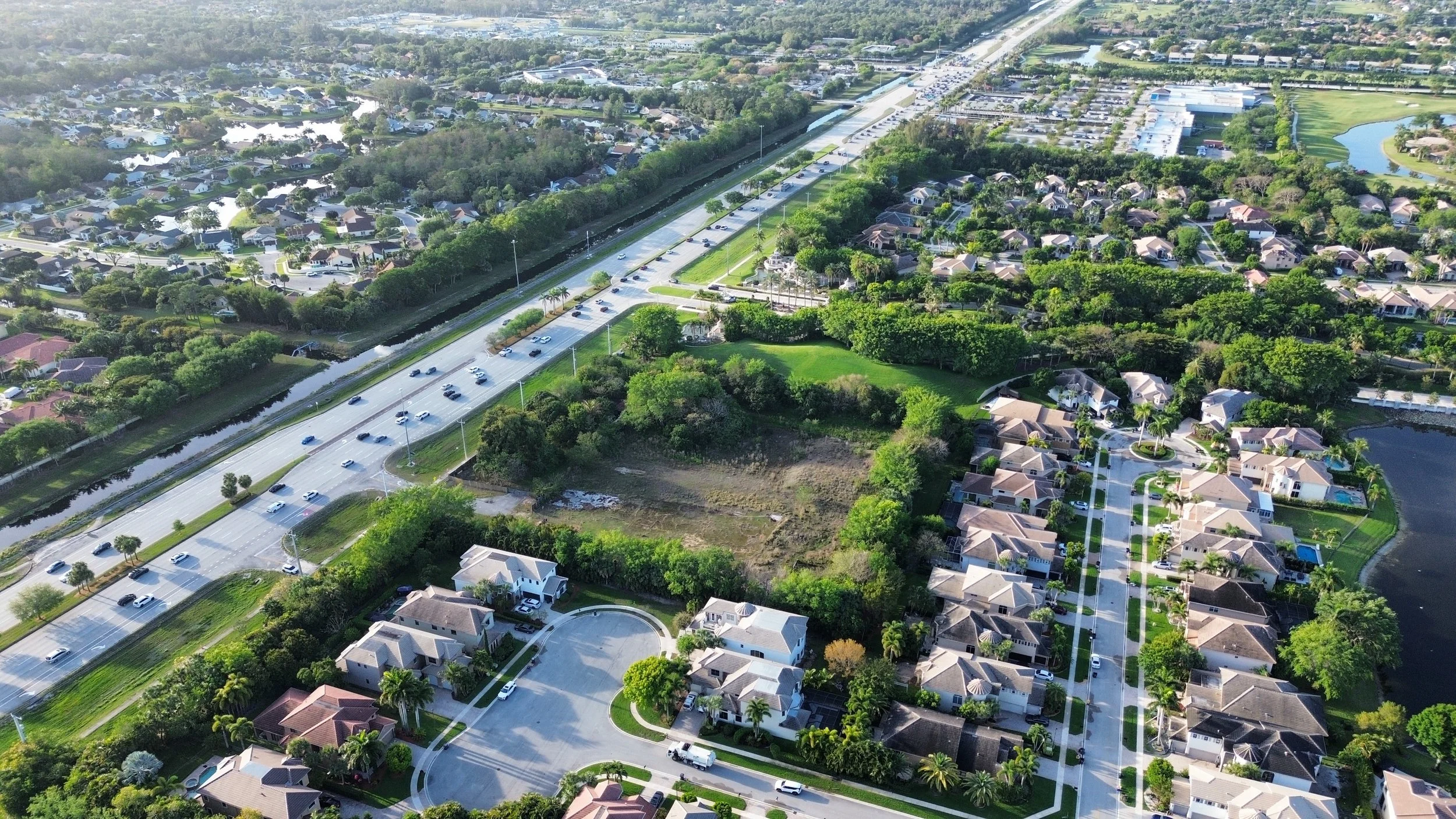
A 3-acre commercial land listing in Wellington, Palm Beach County. Zoning and FAR determine what can be built — and often what the land is actually worth.
This is the conversation most owners never have — and one of the most important ones I can offer.
Sometimes the most valuable thing about a commercial property in Palm Beach County is not what sits on it. It is what the zoning allows to be built there.
Consider a property with a 5,000 square foot building sitting on 3 acres. At face value, a buyer underwrites that based on current income. But if the zoning allows a Floor Area Ratio of 0.4 — which is common across many Palm Beach County, Broward County, and Miami-Dade County commercial corridors — that same 3 acres supports up to 52,272 square feet of buildable space. That is roughly ten times what currently exists on the land.
Ten times the building. Ten times the potential revenue on the end product. An entirely different buyer pool — developers, not just investors.
That gap between what is there and what is permitted is called land value, and it often exceeds the income-based value of the existing structure. Owners who do not know their zoning entitlements frequently leave significant money behind.
Before we have any pricing conversation, I look at the zoning. I look at what is permitted, what has been approved nearby, and whether a redevelopment buyer would pay more than an income investor. In some cases — particularly along commercial corridors in Boca Raton, Delray Beach, West Palm Beach, Fort Lauderdale, and throughout Miami-Dade — that analysis changes the entire picture.
If you own commercial land or a property with excess land in South Florida, the question is not just what your building is worth. It is what your land can become.
The Expenses Most Owners Have Never Looked at Closely
One of the quieter ways I add value is before a property ever hits the market.
I worked with an owner who had held his Palm Beach County property for 40 years. He was thoughtful, patient, and had no urgency to sell — he just wanted to understand his options. As we worked through the numbers together, we looked at every line on his operating statement. His trash bill was significantly higher than it needed to be. With a few calls, we negotiated an 87% monthly reduction. His insurance, which had crept up over the years, was reworked and dropped 40% annually.
Neither of those changes required selling anything. But both flowed directly into his income, which increased his property's value — and gave him a much clearer picture of what he actually owned.
That kind of review should happen before any pricing conversation. Most of the time it does not.
What Shifts Property Values in Palm Beach County
A few things drive the gap between what an owner expects and what the market will actually pay.
Interest rates and buyer financing. When borrowing costs are elevated, buyers need more yield to make a deal work — which puts upward pressure on cap rates and downward pressure on prices. As conditions shift, so does what a qualified buyer can pay. Knowing where that line sits right now matters.
Tenant quality and lease structure. A long-term lease with a national credit tenant trades very differently than the same building with a local tenant on a short-term renewal. Buyers are underwriting risk. The more certainty your lease provides, the more a buyer will pay for it.
The depth of the buyer pool. This is the variable most owners underestimate. A well-run marketing process for a retail property in Boca Raton, West Palm Beach, Delray Beach, or Boynton Beach does not just attract local buyers — it reaches qualified capital from across the country. I ran a process recently that generated over 10 written offers. The owner was genuinely surprised. The property was good, but the process is what created the competition.
Three Things Owners Often Assume That Are Not Quite Right
"I know roughly what it's worth." Most owners anchor to what they paid, what a neighbor sold for, or a number their accountant carries on the books. None of those reflect what a buyer will pay today based on current income, current expenses, and current market conditions. The gap between perception and reality is usually the most useful thing to work through together.
"I'll wait until I'm ready to sell to find out." Understanding your value now — even if you have no intention of selling — is almost always useful. It informs refinancing decisions, estate planning, partnership conversations, and tax strategy. There is no obligation that comes with getting an honest opinion.
"The gross sale price is what I'll walk away with." After commissions, closing costs, depreciation recapture, and capital gains taxes, your net can look very different from your headline number. For owners who have held for many years with a low cost basis, this conversation belongs at the beginning — not the end. A 1031 exchange, an installment sale structure, or other planning tools can meaningfully change your outcome. The right advisor raises these before the listing agreement, not after.
There Is No Single Answer Without Looking at Your Specific Property
Anyone who gives you a valuation number before reviewing your rent roll, your lease terms, and your trailing expenses is working from a guess. That is not what you deserve after years of ownership.
What I do is work through the real numbers with you — at your pace, with no agenda other than giving you an accurate picture. Some of those conversations end in a listing. Many of them just end in clarity, and we revisit the conversation when it makes sense for you.
Owners who go through that process carefully — who understand their true income, who optimize what they can before going to market, and who run a disciplined process to the full buyer pool — consistently achieve better outcomes. I have transacted and advised on over $700 million in commercial properties just like yours across Palm Beach County, Broward County, and Miami-Dade County. I know where the gaps are. Most of them are in the preparation, not the property.
When you are ready to have that conversation, I am here.
Contact Nick McAndrew at Marcus & Millichap to discuss the current value of your commercial property or land in Palm Beach County, Broward County, or Miami-Dade County. Call or text: 561-245-0486 | marcusmillichap.com/advisors/nicholas-mcandrew | nickmcandrew.com
Nicholas A. McAndrew, known professionally as Nick McAndrew, is a Director of Investments at Marcus & Millichap serving Palm Beach County, Broward County, and Miami-Dade County.